All citiesCity guide

Gent

Discover Gent with 4 scavenger hunts full of riddles and puzzles at real landmarks.

Along the way you'll pass Vooruit, Boekentoren, Sint-Pietersabdij, Groot Vleeshuis, Tierenteyn-Verlent, Waterhuis aan de Bierkant, Sint-Baafskathedraal and Belfort van Gent, among other spots.

5.0 on the App Store
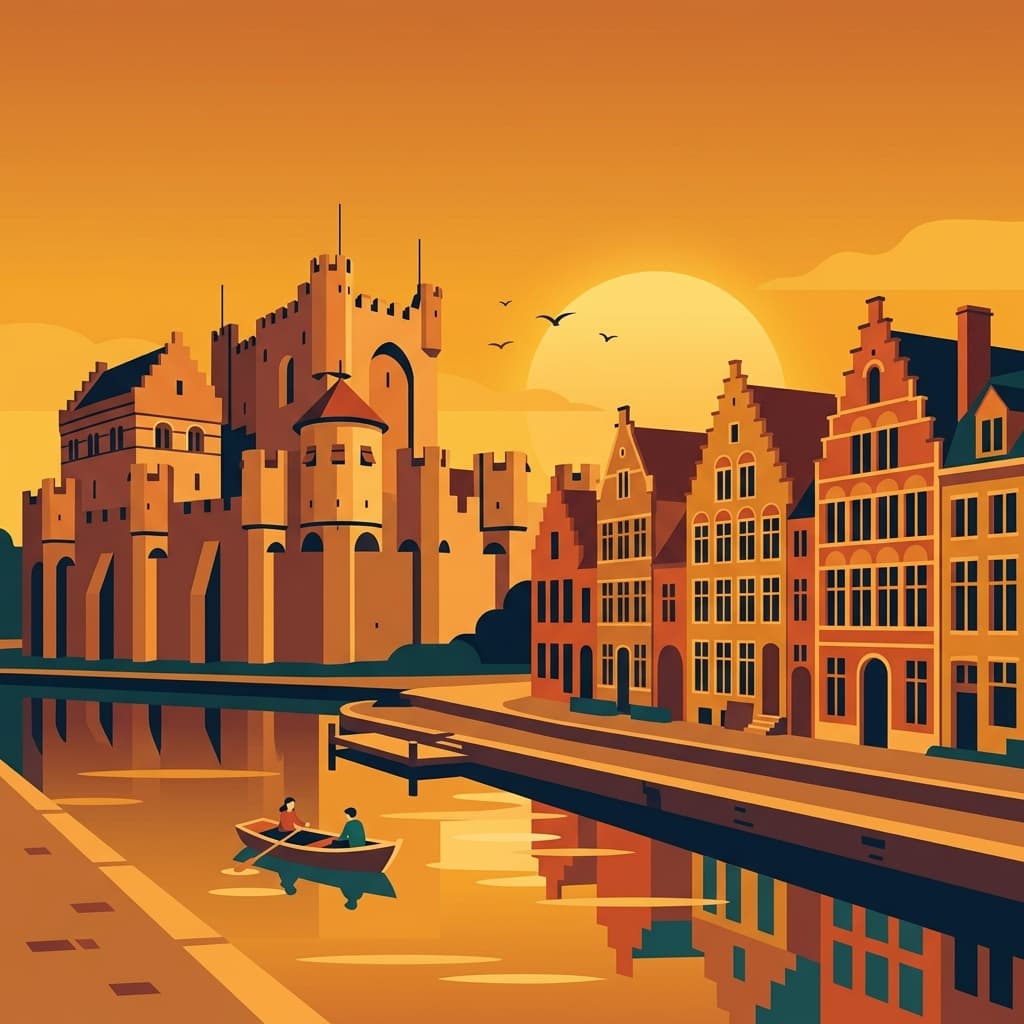
Vintage travel-poster illustration of Ghent

Hunts in Gent

Art, Knowledge & the River

Art, Knowledge & the River

~110 min · 6 stops

Follow the creative pulse of Ghent's southern quarter, from a century-old socialist arts palace to a soaring modernist library tower. Wind through baroque abbey gardens and the green avenues of Citadelpark before arriving at two world-class museums that sit side by side — one dedicated to five centuries of Flemish masters, the other to the most provocative contemporary art in Europe. This is the walk that explains why Ghent has one of the most vibrant cultural scenes of any city its size.

First stops
  • VooruitVooruit — 'Forward' — was built in 1913 as a socialist cooperative festival hall, a bold statement of working-class culture in brick and stone. Its ornate façade and grand ballroom once hosted concerts, theatre and political rallies for the Ghent labour movement. Today it is the city's flagship arts centre, still carrying that spirit of cultural ambition into the student quarter.
  • BoekentorenRising 64 metres over the university district, the Boekentoren (Book Tower) is a masterpiece of Belgian modernism. It was designed in the 1930s as the main library of Ghent University by an architect who, decades earlier, had been one of the pioneering figures of Art Nouveau across Europe — a concrete cathedral dedicated to knowledge. Its slender shape and regular windows give it an austere elegance that still startles visitors walking up from the city centre.
  • Sint-PietersabdijSint-Pietersabdij is one of the oldest and wealthiest Benedictine abbeys in the medieval Low Countries, founded in the 7th century on Blandijnberg hill. Its soaring baroque church and expansive cloister gardens were rebuilt in the 17th and 18th centuries after repeated destructions by fire and iconoclasm. Today the complex hosts exhibitions and cultural events, and its walled vineyard garden remains a tranquil, almost secret retreat in the heart of the city.
A Taste of Ghent

A Taste of Ghent

~90 min · 6 stops

Ghent has been feeding people well since the Middle Ages, and this walk proves it hasn't lost the knack. You'll follow the Leie from a 600-year-old covered meat hall to a mustard shop that hasn't changed its recipe since 1790, stopping for canal-side beers, legendary purple sweets, and a square where you can order a beer only if you surrender a shoe. End your afternoon in the hidden courtyard of a 14th-century almshouse — a quiet corner of the city that most visitors never find.

First stops
  • Groot VleeshuisBuilt in the early 15th century, the Groot Vleeshuis — the Great Butchers' Hall — is one of the oldest covered market buildings in the Low Countries. For centuries, butchers' stalls lined its long nave, trading beneath a magnificent timber-vaulted ceiling. Today the hall is a showcase for East-Flemish regional produce: local cheeses, artisan sausages, and cured meats still hang from those same ancient beams. Step inside and the smells alone will tell you this city takes its food seriously.
  • Tierenteyn-VerlentTucked into the Groentenmarkt since 1790, Tierenteyn-Verlent is one of Europe's last shops still making its signature condiment by hand. The recipe is a closely guarded family secret, and the paste is still fermented daily in the cellar below your feet before being scooped from a large wooden barrel into hand-labelled stoneware pots. A simple piece of bread slathered with this fiery condiment is considered a local delicacy. The shop's interior has barely changed in two centuries.
  • Waterhuis aan de BierkantThe Waterhuis aan de Bierkant — literally 'the Waterhouse on the Beer Side' — has stood at this canal corner for centuries, and its terrace is one of the most scenic beer-drinking spots in all of Belgium. The pub stocks over 150 Belgian beers, with a strong focus on East-Flemish breweries and Ghent-brewed ales. From your seat you can watch the Leie drift past and spot the enormous Dulle Griet cannon across the square. Order a Gentse Strop or a Gruut and enjoy the view.
Heart of Medieval Ghent

Heart of Medieval Ghent

~100 min · 7 stops

Three towers, five centuries of trade, and one legendary painting — this walk threads through the oldest stones in Ghent. You'll cross the bridge that frames the city's iconic skyline, stroll a medieval quay where grain ships once paid their dues, and end at a moated castle that students famously besieged over a beer-price dispute. Each stop peels back another layer of a city that has always done things its own stubborn, exuberant way.

First stops
  • Sint-BaafskathedraalSint-Baafskathedraal began as a simple parish chapel in the 10th century and grew, stone by stone, into Ghent's grandest Gothic cathedral. Its nave took three centuries to complete, each generation adding its own ambitions in limestone and light. Inside hangs one of the most remarkable works of art ever created: the Ghent Altarpiece, painted by Hubert and Jan van Eyck and unveiled in 1432. This polyptych has been stolen, hidden, dismembered, and reassembled more times than almost any artwork in history — Napoleon took it, the Nazis looted it, and it survived two world wars to hang here still.
  • Belfort van GentAt 91 metres, Ghent's Belfry is the tallest of the three towers that define the city's skyline, and the only one not attached to a church. Completed in the 14th century, it served as a watchtower, clock tower, and guardian of the town's most precious charters — the freedoms and privileges wrested from feudal lords over centuries. Since 1377 a gilded mythical creature has perched at the very top, the same figure that once crowned a different tower on this spot. The whole belfry was inscribed as a UNESCO World Heritage Site in 1999 alongside the belfries of Flanders and Wallonia.
  • Sint-NiklaaskerkSint-Niklaaskerk is the oldest of Ghent's three great towers and arguably its most graceful. Built in the distinctive Scheldt-Gothic style, it was funded not by bishops or nobility but by the city's merchant guilds — the people who actually ran medieval Ghent. The church was dedicated to Saint Nicholas, patron of merchants and sailors, an appropriate choice for a city whose wealth flowed along the rivers Leie and Scheldt. Over the centuries it has served as artillery store, stables, and even a revolutionary temple before returning to its original purpose.
Ghent's Quirky Secrets & Rebellious Spirits

Ghent's Quirky Secrets & Rebellious Spirits

~90 min · 6 stops

Ghent has never been a city that bowed quietly to authority. From the iron-fisted cannonmakers of the Middle Ages to the graffiti artists who legally claim its alleyways today, this walk traces a thread of defiance through the heart of the city. You'll stand beside one of the world's biggest surviving medieval bombards, cross the square where Flemish guild leaders toppled counts, squeeze through a lane that reinvents itself in paint every single week, and puzzle over a City Hall that couldn't even settle on one architectural style. Ghent doesn't hide its contradictions — it puts them on display and dares you to look away.

First stops
  • Dulle GrietMeet Dulle Griet — "Mad Meg" — one of the largest surviving medieval bombards in the world. Forged in the early 15th century, this five-tonne iron monster was designed to shatter fortress walls, yet legend insists she fired only once before her operators gave up. She spent centuries scattered across the city in various states of abandonment before finding her permanent home on Vrijdagmarkt in 1578. The name borrows from a Flemish folk character: a ferocious woman too stubborn for even hell to swallow.
  • VrijdagmarktVrijdagmarkt — Friday Market — has been Ghent's political heartbeat for seven centuries. Every major rebellion, riot, and public reckoning played out on these cobblestones. Presiding over it all is Jacob van Artevelde, the wealthy cloth merchant turned populist leader who forged an alliance with England in 1337 and made Ghent one of the most powerful cities in northern Europe. His bronze statue points defiantly at the surrounding guild houses, many of which still bear the emblems of the brotherhoods that ran the city.
  • Werregarenstraat (Graffitistraatje)This narrow alley is only about 80 metres long, but it contains more paint per square centimetre than anywhere else in Ghent. Since the 1990s the city has officially tolerated — even encouraged — graffiti artists to cover every surface here. The result is a living gallery that never shows the same face twice: by the time you visit, last week's masterpiece has been transformed into something entirely new. It is one of very few legal graffiti zones in any medieval European city centre.
Frequently asked questions

Scavenger hunts in Gent: practical questions

How long does a scavenger hunt in Gent take?

The hunts in Gent take roughly 90 to 110 minutes and have 6 to 7 stops. You walk at your own pace and can pause and pick up again anytime.

How much does a scavenger hunt in Gent cost?

A hunt costs €1.99 as a one-time purchase in the app — no subscription. You can also unlock the whole city with all themes at once.

Which themes are available in Gent?

There are 4 hunts in Gent: Art, Knowledge & the River, A Taste of Ghent, Heart of Medieval Ghent, Ghent's Quirky Secrets & Rebellious Spirits. Each theme follows its own route past different places.

Can I play together in Gent?

Yes — play solo, share one phone, or try the co-op duo mode (beta) with two phones. For groups and team outings there are private hunts everyone joins in the browser.

Your next adventure starts at the corner.

Download Cluventure, pick a city, and let the hunt begin.

Download on theApp Store